
|
| »
Renewable
Electricity
|
You
can Contribute to a Hopeful Future
Free from Smog, Acid Rain and Greenhouse Gases
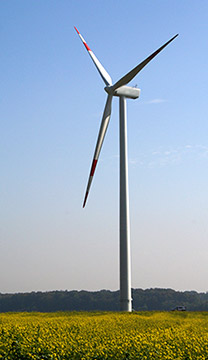
The fastest growing energy source in the country is renewable energy and the Energy Cooperative of America is pleased to be able to offer our customers a 100% renewable energy supply option. This clean source of energy is comprised of wind, hydro, and bio mass. We are able to offer this green energy alternative to our New York customers in the National Grid, Rochester Gas & Electric, New York State Electric & Gas and Consolidated Edison utility territories.
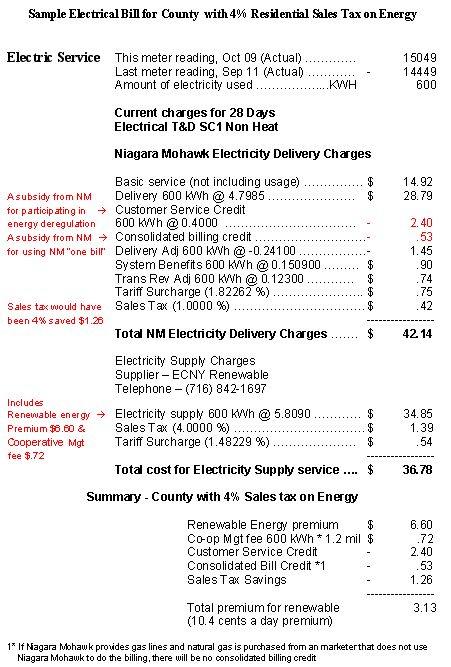
The cost of producing renewable energy is slightly higher than conventional electricity, aka “brown power.” As a result, there is an additional charge of 1 cent per kilowatt hour (Kwh) for the renewable energy supply option. For example, if conventional electricity is selling for $0.05 per Kwh then you would add 1 cent to that per Kwh price, making the total cost for renewable electricity supply $0.06 per Kwh.
For the average residential customer with an annual usage of 8,400 kilowatt hours per year, the added cost for exercising this option is approximately $84 per year. We applaud the many customers that are currently utilizing renewable electricity and their commitment to reducing their environmental impact.
Customers interested in learning more about programs and funding available for decreasing their carbon footprint may visit the New York State Energy Research and Development Authority (NYSERDA) website at www.nyserda.ny.gov
The Advantages of Renewable Energy
For
the first time in New York State history, as a result
of energy deregulation, it is now possible to direct
your “consumer vote” to support a 100%
renewable source of energy that:
-
Does not damage people’s health
– the generation of conventional fossil fuel
electricity results in the creation of NOx (Nitrogen
Oxides) which are one of the key ingredients of Smog.
Smog, Ozone, and small particulate particles associated
with coal burning are credited for endangering human
health especially to people with asthma and other
lung diseases
- Supports
our environment – Conventional electricity
usually leads to the creation of SO2 (Sulfer Dioxide)
which is one of the main ingredients of Acid Rain.
Acid rain is credited for damaging the environment,
in particular the lakes as well as the forests in
the Adirondacks and New England.
- Generates
no climate changing Greenhouse Gases –
Fossil fueled electricity by definition creates CO2
(Carbon Dioxide) gas. CO2 is a greenhouse gas that
contributes to global climatic change.
- Creates
no radioactive waste – Conventional
nuclear power creates radioactive wastes that will
remain dangerous and must be taken care of for thousands
of years.
-
Spares the world’s resources
– Fossil fuels are a finite resource that once
used can never be used again. Renewable energy resources
by definition do not burn nor deplete fossil fuels.
How the Program Works
The
renewable electricity offered in this program is:
Hydropower
facilities in the United States can generate enough
power to supply 28 million households with electricity,
the equivalent of nearly 500 million barrels of
oil. 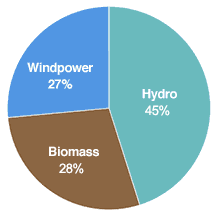 Mechanical
energy is derived by directing, harnessing, or channeling
moving water. The amount of available energy in
moving water is determined from its flow or fall.
Hydropower produces no waste products, and it does
not pollute the water or the air. Mechanical
energy is derived by directing, harnessing, or channeling
moving water. The amount of available energy in
moving water is determined from its flow or fall.
Hydropower produces no waste products, and it does
not pollute the water or the air.
The
Biomass energy in this program is
landfill methane fired electricity. Landfill fired
electricity takes methane, an unavoidable byproduct
of landfill decomposition and burns it in a turbine
to generate electricity. This takes the methane,
a powerful greenhouse gas 21 times more potent than
CO2, and converts it into Carbon Dioxide. Each unit
of methane burned removes the equivalent of 20 units
of CO2 out of the environment. At the same time,
each unit of electricity created from landfill methane
replaces a unit of fossil fueled electricity and
the CO2 that would have been created by that fossil
fueled energy.
The Wind Power
is generated at commercial wind farms in New York
State.
The way this program works, you are still using
the utilities wires and the utility is still providing
emergency service and meter read services (and in
fact we are paying the utility to bill you). If
you sign on to the renewable program, for every
unit of electricity you use, the Cooperative is
required to purchase that number of renewable units
and place them into the utilities system. The “green
electrons” don’t necessarily go directly
to your house. However, if you or someone else is
not buying them, there is no reason for the Cooperative
to buy them and no reason for the generators to
produce them. The New York State Public Service
Commission will audit the total amount of renewable
energy that our members bought and the Cooperative
purchased and the renewable generators placed into
the utilities system to make sure we are all getting
the renewable power that we are paying for.
By casting your “consumer vote” in support
of renewable energy, you will be:
• creating a market demand
for cleaner energy
• encouraging developers
to build more renewable generation facilities in
New York State.
The
Energy Cooperative of America purchases
all of our renewable energy from distributors located
in New York State.
How
Much Does This Cost?
Normally
you would expect to pay a little more for renewable
energy. This is partly because most renewable
energy facilities are relatively new and need
to pay for their construction costs while most
conventional electrical generation facilities
are older and have already paid for their construction.

This program is selling the renewable electricity
for 1 cent per Kwh more than the price of conventional
electricity.
Those customers who leave National Grid, RG&E or NYSEG as their
energy provider to join the Energy Cooperative
will take advantage of the benefits from energy
deregulation which will save around a third to
a half a penny per Kwh. This will result in a
net additional cost for the combination of renewable
energy plus energy deregulation of just over half
a penny to three quarters of a penny per Kwh more
than conventional energy (for a residential account
with the average usage of 600 Kwh a month, this
should work out to around ten to
fifteen cents a day more than
the price of conventional power).
|
|
|




 Residential
 Commercial




